Wanted Persons databases in Greenville let the public check if someone is actively sought by law enforcement, offering a quick way to verify a name, photograph, or alias against the latest wanted list. By entering a suspect’s name, date of birth, or case number, users can instantly see if an outstanding warrant exists, see the alleged offense, and learn the issuing agency. This fast, accurate search helps families, employers, and community members stay informed while supporting public safety initiatives.
Wanted Persons search tools also guide users on how to report tips safely, explaining the proper steps to submit an anonymous lead without approaching the individual. When a new arrest or capture occurs, the system updates within hours, reflecting changes such as removed listings or newly added wanted individuals. Understanding these updates ensures you get the most reliable information and know exactly who to contact for any concerns about a potential suspect.
How to Search Wanted Persons
Wanted Persons records let you check a public police listing by legal name, alias, photograph, date of birth, or case number when those fields are available. The Greenville County Sheriff’s Office portal is the official starting point for a Greenville-area search. Users can also reference deed records for additional information. A result may show an alleged offense, warrant status, issuing agency, case number, and other identifying details. A listing reports agency action, not a conviction, so confirm the current status with the agency named in the record before acting on it.
Official Search Portal: https://gcso.org/
Steps to Search
- Visit the official Greenville County Sheriff’s Office website and look for its wanted persons or fugitives section.
- Enter the person’s full legal name and try spelling variations if needed.
- Add details such as date of birth or case number to narrow the results.
- Compare photographs, aliases, and other identifiers to avoid confusing people with similar names.
- Review the warrant status, case number, alleged offense, and record date.
- Contact the agency listed to confirm whether the warrant is still active.
- If no result appears, check other spellings or contact the relevant agency directly.
- Never confront a listed person. Report sightings to law enforcement through official channels.
What You Can Compare in a Wanted Record
After you find a possible match, compare several fields before treating the page as a confirmed active listing. The exact fields depend on the agency and the case. A missing photograph, address, height, weight, or last known location can reflect a limited public notice rather than a complete case file.
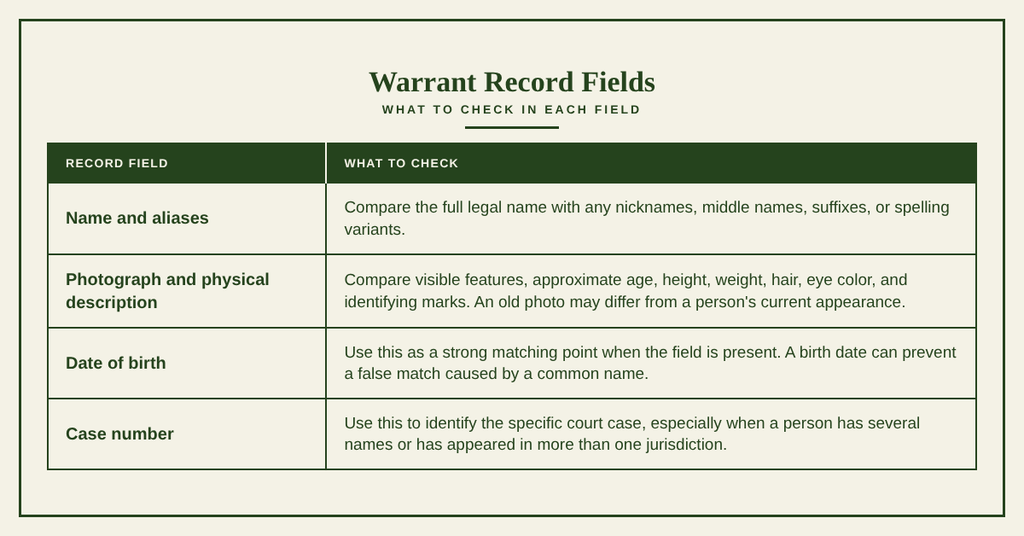
Search by name works best when you use every reliable identifier you have. Search by photograph works best when you compare the image with several features rather than relying on a general resemblance. Search by case number gives the cleanest result when the case came from a court notice, attorney, court clerk, or another agency. A public wanted-person search is one source, not a substitute for an agency status check.
Classifications and Reasons for Wanted Listings
Public wanted lists can contain several kinds of cases. A person may appear because a court issued an arrest warrant, because a case is active, or because an alleged violation of probation, parole, or custody terms needs attention. The reason shown in the record is more useful than a general heading such as Most Wanted, which often reflects agency priority rather than a separate charge. Read the case fields and treat the listing as an alert for verification, not as proof of guilt.
Active Arrest Warrants and Serious Criminal Allegations
An active arrest warrant is a court order that authorizes police officers to arrest a person. A public notice tied to that warrant may include a photograph, physical description, alleged offense, case number, and the agency or court that issued it. The person has not been found guilty merely because the name appears; the record describes a legal process that remains active until the court or agency records a change.
A serious criminal allegation in a wanted listing can point to a case involving assault, robbery, fraud, drug offenses, or other alleged conduct. The exact charge depends on the court record, so read the offense field rather than infer the facts from a headline. A case number helps distinguish the matter from another case with a similar name. Bond conditions, geographic limits, and the scope of a warrant may differ by charge, so ask the named agency how the record should be read.
Failure to Appear and Court Orders
A failure-to-appear entry, often shown as FTA, can arise when a person misses a required court date, hearing, or scheduled meeting. The underlying charge may be serious or may involve a lesser offense; the missed appearance can create a separate court process. A judge or court may issue a warrant for the person’s arrest, or the agency may handle the matter under a different court instruction.
Another court order can require a person to appear, surrender, register, or complete a specific requirement. The record may identify the issuing court and the case number instead of naming one police agency. For an FTA or court-order question, contact the court or agency shown on the listing. A local sheriff’s office may display a case originating with a municipal court, state court, or another county, so the issuing court can often clarify the legal status.
Probation, Parole, and Custody Violations
Probation and parole place a person under court or agency supervision. Conditions can include reporting to an officer, meeting a curfew, passing a drug test, completing classes, or staying away from a specified place. An alleged violation can lead to a review, a new charge, a warrant, or a court hearing. A public listing connected to one of these violations does not describe every fact of the original case.
A custody violation can involve an alleged failure to meet a condition set by a court, correctional agency, or supervising office. The agency may list the person for a new warrant or request help locating the person after an absence. Read the violation wording, supervising agency, case number, and status together. For a current status check, the supervising agency or issuing court can distinguish a new violation from the original offense.
One Name, Several Possible Statuses
The same person can appear under different statuses as a case moves through the system. An active warrant notice may remain on a page after a person is located, arrested, released, or has a warrant recalled. A capture notice may also be followed by a removal entry after the agency updates its files. A search result that says located does not always mean arrested, and a search result that says captured does not always mean the public page has already been removed. Check the date and ask the responsible office which status controls.
Reporting Leads and Safety Procedures
If a search result matches someone you know, the safest response is to give the agency useful facts without making contact. Do not confront, follow, or try to control the person. A useful report names the place, time, direction of travel, and what you actually saw. The agency named in the listing should receive the report, and local police should handle a situation involving immediate danger.
Submitting an Anonymous Lead
Some agencies accept anonymous reports through a dedicated form, phone line, mail process, or other reporting channel. The official portal may provide a reporting link, or it may direct you to a phone number and published office hours. You can also access death records to review official records. A form on an unrelated site does not guarantee that the agency will receive your report. Before sending facts, check the site owner, the contact method, and any statement about how a reporter’s identity is handled.
Give the agency the case number and the name shown on the public record whenever possible. If you report a sighting, state when and where it occurred and describe only what you personally observed. Ask the agency whether a callback number or another safe contact method is available. Keep a copy of what you submitted so you can identify the report if you need to follow up.
Details to Include in a Lead Report
A clear report separates observed facts from guesses. That distinction helps an officer decide where to look and prevents a mistaken assumption from becoming the focus of the search. Organize your notes in the order that events happened, and include only details you can recall with reasonable confidence.
- Identifying details: legal name, alias, date of birth, height, weight, hair and eye color, identifying marks, and case number, if known.
- Time and place: the date, approximate time, street address or nearby business, and the side of the building or road where you saw the person.
- Direction of travel: the route the person took after you noticed the person, including whether the person entered a vehicle, building, or parking area.
- Clothing: a plain description of the jacket, shirt, pants, shoes, hat, bag, or other visible items. Avoid a vague label when a more specific description is possible.
- Vehicle details: make, model, body style, color, visible damage, and a plate number only if you can read it safely without pursuing the vehicle.
- Actions observed: what the person did, such as entering a store, speaking with another person, placing an item in a vehicle, or leaving an area.
- How you recognized the person: describe the specific face, clothing, vehicle, or combination of details that made you compare the person with the record.
- A safe callback method: a phone number, email address, or other method supplied by the agency. Never give an address or workplace where an unauthorized person could reach you.
Keep original notes, messages, and photographs in their original form. Do not crop a scene, alter a date, or publish a name as fact. If you are unsure about one detail, mark it as uncertain rather than presenting a guess as an observation. A short report with a clear timeline and exact location can be more useful than a long report filled with unsupported claims.
Direct Police Contact and Avoiding Approach
Call the agency named in the record for a non-emergency sighting. If that office cannot be reached, contact the local police department serving the place where you saw the person. For a threat in progress, missing child, immediate danger, or an active crime, call 911. Give the dispatcher the same identifiers that appear in the record so the response team can compare the person with the notice.
Keep a safe distance and do not block the person’s path. Never touch the person, search a bag, take belongings, or follow the person by car or on foot. A wanted person may react unpredictably, and your safety matters more than preserving a detail that can be reported later. If the person enters a private home, restricted property, or workplace, leave the area and tell the agency what you observed.
Do not ask another person to confront the listed person, and do not post a live location, photograph, or accusation on social media. Public posts can spread faster than an agency can correct a mistaken notice. If you witnessed conduct that may be unlawful, describe the conduct and its location; let the agency decide what action is lawful and necessary.
If the Person Appears at Work or in a Public Place
A manager or supervisor should contact the agency without detaining, searching, or publicly confronting the person. An employer can provide a private work location, schedule, photograph, badge number, or other facts if the agency requests them. Do not announce a person’s status to coworkers or customers unless police direct you to do so.
If the person leaves without a confrontation, record the time, direction, vehicle, and any new identifiers. Give those facts to the agency rather than starting a pursuit. If the person behaves calmly and causes no immediate threat, leave them alone while the agency checks the case. A prompt, factual report gives officers more value than an attempt to control the situation yourself.
Record Accuracy and Resolution
A public wanted-person page is a working record, not a permanent or complete history of every case connected to a name. A page can be accurate when it is posted and outdated after an arrest, court hearing, warrant change, or removal. The date, case number, and issuing agency should be checked together. For a time-sensitive question, a direct status check with the responsible office is more dependable than a saved page or a search result with no date.
Delays in Updating Status for Captured or Located People
A public page can lag behind a court or field event. After an arrest, the agency may need to confirm the booking, compare the case number, receive a court update, and revise the posting. A warrant can also be recalled, quashed, satisfied, or resolved through a bond or other order. Until the agency updates the page, an old active notice may remain visible even though the underlying case has changed.
A sighting is not the same as a capture. A person may be located at a home, workplace, hospital, airport, or other place and then leave before officers arrive. The agency may mark a record as located before it decides whether an arrest occurred. Do not describe someone as captured based on your own observation. Report the sighting and let the agency assign the status.
System Processing Time for Recently Added Listings
A newly added listing can require several checks before it reaches the public page. The agency may need to confirm the warrant, case number, photograph, identifying description, and requested location limits. A court record may need to be matched with an existing case, and the public notice must meet the agency’s rules for posting. Those steps can take different amounts of time for different records.
There is no safe universal interval for every wanted-list update. Do not assume that a page will change within a set number of hours unless the agency states that policy for that record. Individuals can also check death index to verify relevant details. The date on a listing tells you when the agency published or last changed the entry, not when a case will close. For a newly added person, a recent date, or a sudden status change, call the named agency for confirmation.
Sealed, Confidential, and Restricted Agency Records
Not every case file is available to the public. A court may seal a case, and an agency may limit access to investigative files, active warrants, juvenile matters, personal identifiers, or records involving ongoing proceedings. A public notice can show a name and basic offense while leaving out the supporting affidavit, detailed evidence, or a current photograph. A restricted record can still have legal significance even when most of its details are unavailable.
If a record cannot be found, ask the issuing court or agency what form of public notice applies. Some offices provide a case-status check, a records request, or a telephone confirmation without giving you the full file. Saved or archived pages can show an old status that no longer applies. Do not try to work around a legal restriction, and do not treat a missing photograph as proof that a person has no warrant.
Jurisdiction and Interagency Checks
A person can be listed by a county sheriff’s office, municipal police department, court, state agency, or federal agency. The Greenville County portal may emphasize local postings, so a separate state or federal record may not appear in the same search. A warrant issued in one county can still be active while the person lives or is found in another county. The case number and issuing agency determine where the inquiry belongs.
When a listed person is found outside Greenville County, the agency with local authority can verify the warrant and coordinate with the issuing office. That coordination may involve neighboring jurisdictions, a state agency, or a federal agency. Whether an interstate case uses extradition or another approved legal process depends on the charges and court orders. A civilian should not try to transport, restrain, or deliver the person; report the location to police and let the agencies handle the legal process.
Resolving an Incorrect or Outdated Listing
When a listing appears wrong, compare the exact name, photograph, date of birth, case number, alleged offense, issuing court, status, and page date. Save the page address and date, and keep a clear note about the problem. A copy of a social media post can show an old image or a removed listing, so the agency record is the place to begin the correction request.
Ask the agency to review the entry and explain which fields are current. If the problem is a court case number, status, or filing, ask the court clerk for the case record. If the problem is a photograph, alias, or agency posting, ask the office that maintains the public page. Keep a written response, and use the agency’s records or complaint process for a formal correction. A listed person should request the applicable review process rather than confronting witnesses or publishing the dispute online.
There is no single public-list duration. A person can remain listed until the agency or court records a capture, recall, dismissal, bond resolution, warrant satisfaction, or other case change. A removed listing can later reappear if another case or warrant is added, and a new case number can appear under the same name. Read each record as a separate legal event and ask the responsible office which entry now controls.
If several offices give different answers, provide each one with the same identifiers and ask which agency has the active case. A law-office or court record may be newer than a public web page, while an agency may have received a court order that has not yet reached the posting team. Document each response with its date. This record makes it easier to resolve the next question without relying on an old search result.
Contact Information
Use the details below for a Greenville County wanted-person search, a non-emergency status check, or a report about a person seen on a public list. For an immediate threat or active danger, call 911. Do not send documents or personal records through an unverified message service.
Frequently Asked Questions
Below are quick answers for people looking up wanted persons in Greenville County.
How can I search for a wanted person online?
The Greenville County Sheriff’s Office runs an online portal at https://gcso.org/. Enter the legal name, known alias, or case number in the search fields. The system returns any matching wanted persons records, showing a photograph, date of birth, and alleged offense when available. Results also list the issuing agency and warrant status. If no match appears, the individual may not be listed publicly. For further help, call the office at (864) 271-5210 during business hours.
What information appears in a wanted persons list?
A typical wanted persons list includes the person’s name, any aliases, a photo, date of birth, and physical description such as height and weight. It also shows the alleged offense, case number, warrant status, and the agency that issued the warrant. Some entries note the last known address or location. The list reflects law‑enforcement actions, not convictions, so you should verify current status before taking any action.
How do I verify if someone is currently wanted?
Start with the official Greenville County Sheriff’s Office website. Use the search tool to look up the person’s name or known aliases. If a record appears, check the warrant status column; it will say active, pending, or satisfied. You can also call the sheriff’s office at (864) 271-5210 to confirm the information. Keep in mind that some records may be restricted, so the online list might not show every active case.
Where can I report a tip about a wanted suspect?
Tips can be submitted directly to the Greenville County Sheriff’s Office. Call the tip line at (864) 271-5210 or use the online tip form on https://gcso.org/. You may remain anonymous if you prefer. Provide as many details as possible, such as the suspect’s name, description, last known location, and any vehicle information. Law‑enforcement will assess the tip and follow up according to their procedures.
How often are wanted persons records updated?
The sheriff’s office updates its wanted persons database regularly, typically after each new arrest, warrant issuance, or status change. Updates may occur daily, but the exact timing depends on internal processing. If you need the most current information, check the online portal and then call the office to confirm any recent changes.